
Hotfix vs Full Release: How Mobile Teams Should Treat Them Differently
Treating every mobile release the same creates confusion when a crash fix lands next to a spring catalogue launch. How to separate hotfix urgency from full-release process without losing control.

A payment crash at 9am and a spring catalogue launch next Thursday should not look identical in your release channel. Yet on many mobile teams, they do — same checklist, same thread title, same "can someone check App Store Connect?" energy. Stakeholders cannot tell whether you are shipping a one-line fix or a quarter's worth of features. QA does not know which regression suite to run. Leadership assumes "submitted" means "going live tonight."
Mixing hotfixes and full releases in one undifferentiated process is how teams lose trust in their own release rhythm.
Why mobile makes the distinction harder
On the web, a hotfix is often a revert or a flag flip. On mobile, every fix is a new binary, a new store submission, and another wait in review. "Hotfix" does not mean instant. It means narrower scope and higher urgency — not exemption from Apple or Google.
That gap between urgency and store reality is where confusion breeds. The CEO hears "hotfix" and expects users patched before lunch. Engineering knows review might take until tomorrow. Without explicit labelling and a slimmer workflow, everyone projects their own definition onto the same Slack thread.
What a hotfix release actually is
A hotfix release should be boring on purpose. One defect, one fix, minimal surface area. The goal is restoring safety or core functionality — crash on launch, broken checkout, auth loop — not sneaking in the feature that was "almost ready anyway."
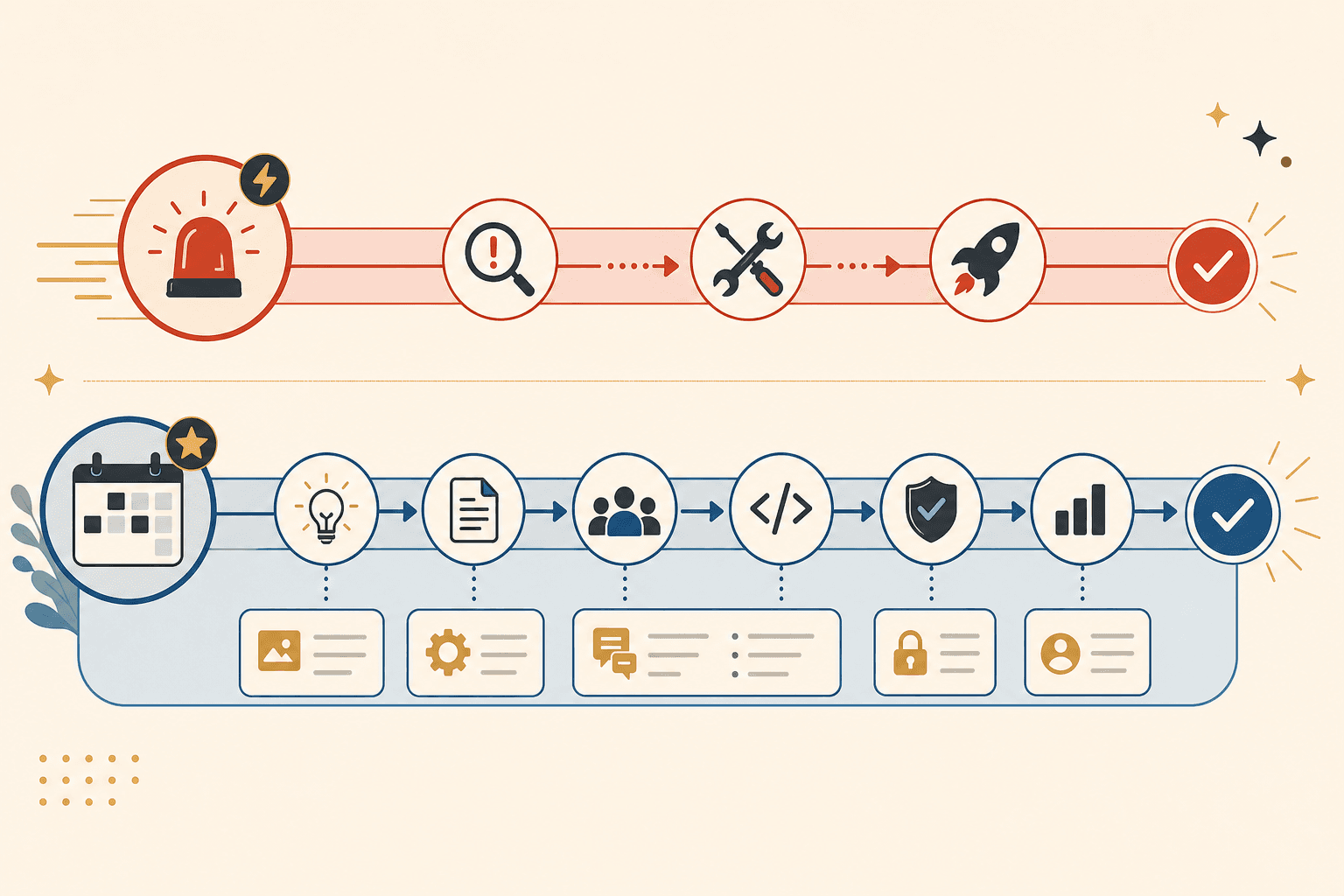
That discipline is cultural and operational. Culturally, teams agree that hotfix trains do not pick up extra passengers. Operationally, the checklist shrinks: targeted regression on the failure path, expedited review notes, clear comms that this build does not include unrelated work.
Full releases carry the opposite posture. Broader QA, release notes aimed at users, coordination with marketing and support, and explicit go-live timing that may lag store approval by days. The spring catalogue waits for the photoshoot, not for the compiler.
The cost of using the full checklist for everything
When hotfixes run through the same heavyweight process as major releases, two bad things happen. Hotfixes slow down — every optional step becomes mandatory because the template says so. And full releases feel chaotic — people start skipping steps "because we did that on the last hotfix," eroding the checklist everyone else depends on.
The fix is not two completely separate tools and two separate channels. It is one visible workflow with a release type that changes expectations at a glance. A hotfix flag tells PMs not to ask for the full regression report. It tells leadership the scope is intentionally small. It tells on-call engineers they are not approving a feature bundle at 11pm.
Communicating scope so the channel stays sane
Naming matters. A thread titled "iOS release" could be anything. "Hotfix: crash on cart — iOS 2.14.1" sets the frame immediately. Pair the title with a one-line scope statement in the opening message: what broke, what changed, what is explicitly out of scope.
For full releases, the opening message should list themes and link to the ticket or changelog source of truth. Store review still applies to both paths — hotfixes need crisp review notes on the user-visible bug; full releases need complete metadata and staged rollouts. The process differs in depth, not in whether you respect the stores.
Who can skip what — and who cannot
Hotfix workflows can trim ceremony; they should not trim accountability. Someone still owns build verification, store submission, and post-release monitoring. What you may skip is full exploratory QA across unrelated modules, executive readouts, and coordinated marketing pushes.
Define these skips in advance, not during the incident. If the answer to "can we skip regression on settings?" is "ask in the thread," you will get a different answer depending on who is awake. Write the hotfix path down: minimum tests, required approvers, maximum time from merge to submit.
Full releases keep the broader gates — sign-off from product, legal if needed, support briefed with known issues. The spring catalogue launch does not get expedited because the team is tired from last week's fire drill.
Keeping history straight when both happen close together
Teams often run a hotfix in the same week as a planned release. Without clear labelling and history, retrospectives blur — did the crash spike follow the hotfix or the catalogue build? Record type, version, scope, and outcome separately for each train so you improve cadence from facts, not memory.
Bringing it together in Slack
Mobile teams already coordinate in Slack. The release workflow should live there too — not as a static checklist in a doc, but as a live thread with steps, owners, and a visible hotfix or full-release badge. When the on-call engineer opens a hotfix at midnight, the channel should instantly read differently from the marketing launch thread pinned above it.
That clarity reduces the questions nobody should have to ask: Is this the crash fix or the catalogue? Are we allowed to go live? Who is waiting on review?
ReleaseSteps supports hotfix releases alongside your standard workflow so the channel shows release type at a glance — same tool, different urgency, no confusion between emergency and planned.